

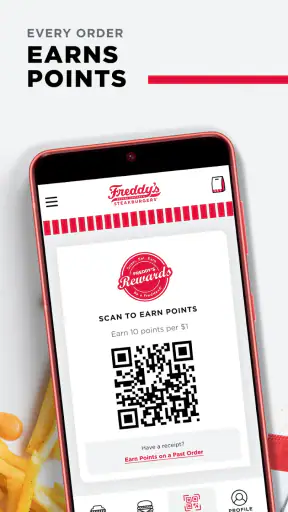
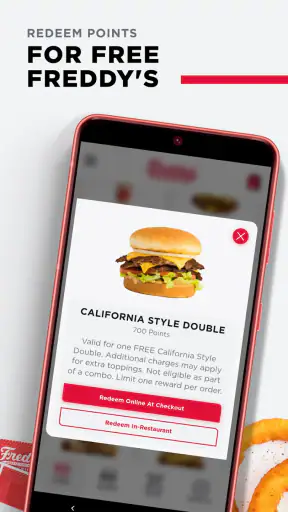
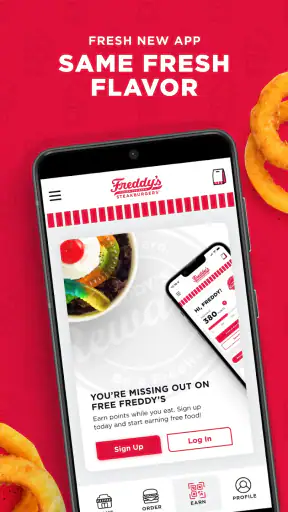
I tend to judge a restaurant app by what happens between “I’m hungry” and the moment the order is actually ready. Does it make the choice easier, keep the ordering process clear, and give me a useful reason to open it again? Freddy’s is built around that simple routine. It is a free Food & Drink app from Freddy's LLC that lets me order for carry-out, delivery, or dine-in while earning points on orders.
That combination makes it more than a digital menu, but it is not automatically the best tool for every meal. Its value depends on how often you visit Freddy’s, whether you prefer ordering directly or through a general delivery service, and how much you care about keeping rewards connected to your purchases. I found it most convincing when I already knew I wanted Freddy’s and wanted a direct way to organize the order.
How I decided whether Freddy’s was worth keeping
My first test was convenience. A restaurant app should reduce small decisions rather than create new ones. I looked at the app as part of an ordinary routine: choosing a meal after work, arranging food for more than one person, and deciding whether to pick it up or eat at the restaurant. Freddy’s has a clear purpose in each of those situations because the ordering options are built around the restaurant’s own service rather than around a broad marketplace.
The second test was repeat value. A one-time order can be handled in many ways, including walking in or using a delivery platform. The stronger reason to install a dedicated app is that future orders become easier and points accumulate in the same place. That makes direct ordering with rewards the central idea to consider, not the novelty of having another app on a phone.
I also considered flexibility. Some people want delivery above everything else. Others prefer carry-out because they are already passing the restaurant, while dine-in customers may simply want a faster way to plan their visit. Freddy’s supports all three order contexts, which gives it a wider use case than an app focused only on pickup. Still, the best choice can change depending on the meal and the alternatives available locally.
For a first-time visitor, I would not install it solely because it is free. I would first decide whether Freddy’s is likely to become a repeat stop. For a regular customer, the calculation is different: keeping a dedicated app can be worthwhile when the points and direct access make each later order less effort. That is the practical threshold I would use.
The everyday scenario where it makes the most sense
Imagine I am leaving work and want food for myself and another person. One of us wants carry-out, while the other would rather eat at the restaurant if the timing works. Opening a general delivery marketplace could show many choices, but it also adds a comparison step that is not useful when Freddy’s is already the preferred destination. In this situation, I would use the restaurant app to choose the service style first, build the order, and keep the transaction tied to the rewards system.
The important detail is the order of decisions. I would settle the pickup, delivery, or dine-in plan before spending time customizing the meal. That avoids treating the app like a restaurant directory and makes it function as a planning tool. If the timing changes, I would reassess the service option rather than assuming the original choice is still convenient.
This workflow is especially useful for households where one person places the order for several people. A dedicated restaurant app keeps the target restaurant fixed, so there is less risk of accidentally switching to a different listing or missing the reward credit associated with a direct order. It does not remove the need to check the final details, but it gives the order a consistent home.
What Freddy’s does better than the usual alternatives
The biggest advantage is focus. A delivery marketplace is helpful when I am undecided and want to compare restaurants, but that breadth can become clutter when I already want Freddy’s. The dedicated app narrows the task to ordering from one brand. That can make the experience feel more intentional: I am not browsing an endless list, I am completing a specific meal plan.
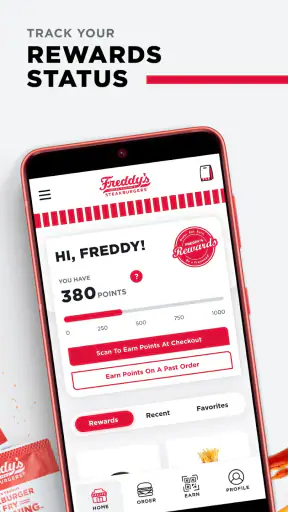
Rewards are another meaningful difference. Earning points on every order gives repeat customers a reason to use the direct channel instead of treating each purchase as an isolated transaction. I would not view points as a reason to order food I did not want, but they can influence the choice between two otherwise similar ways to place the same Freddy’s order. This is one of the app’s strongest practical arguments.
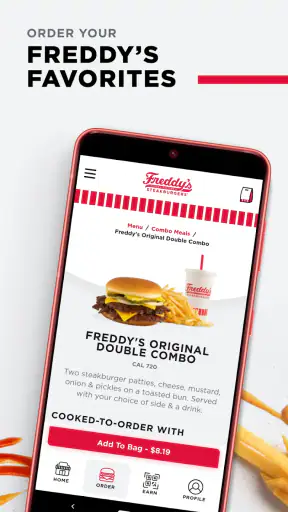
It also covers three distinct occasions. Carry-out suits a quick stop, delivery suits a meal at home, and dine-in suits a visit where I want to eat at the restaurant. That range matters because many restaurant tools are most useful in only one setting. Here, the app can remain relevant even when my schedule changes.
A further strength is the reduced switching between restaurant information and ordering. When I use a general platform, I may have to think about whether the correct location, service type, and restaurant listing are selected. With a brand-specific app, the mental task is narrower. That does not guarantee a perfect order, but it can reduce the number of unrelated choices competing for attention.
The app’s scale also suggests that it has become a familiar tool for many customers: it has more than a million installs, an average rating of 4.7, and roughly 34 thousand ratings. I treat those figures as useful context rather than proof that every interaction will be smooth. A high average can indicate that the core experience works for many people, while individual convenience still depends on location, timing, and personal ordering habits.
Small habits that make the app more useful
My first tip is to think of the app as a repeat-order shortcut, not just an emergency ordering method. If I use it only when I am already rushed, I am more likely to overlook the service choice or rush through the final review. Opening it a little earlier gives me time to decide whether carry-out, delivery, or dine-in actually fits the evening.
My second tip is to treat rewards as part of the payment decision before placing an order. If I am comparing the dedicated app with a third-party marketplace, I would ask two questions: which option is more convenient for this specific order, and which one keeps the purchase connected to Freddy’s points? That simple check prevents me from choosing a marketplace automatically when direct ordering would have been just as easy.
My third tip is useful for group orders. I would collect everyone’s choices before opening the final ordering flow, then use the app to assemble the meal in one deliberate pass. This reduces the chance of placing partial orders or forgetting who asked for what. It also makes the reward-earning purpose clearer, since one coordinated order is easier to track than several separate decisions.
For dine-in, I would use the app as a planning aid rather than assuming it replaces the restaurant experience. The value is in organizing the order around the visit, while the actual appeal of eating in remains separate. That distinction matters for people who are deciding between ordering ahead and simply choosing food after arriving.
Where the alternatives may fit better
Freddy’s is not the right choice when I am genuinely comparing several restaurants. A broad delivery service is better for that job because it puts different cuisines and restaurants in one place. If my priority is discovering what is nearby rather than returning to Freddy’s, the dedicated app adds an extra step instead of removing one.
A marketplace may also be preferable when I already use it for household orders and want one place to manage several restaurants. The trade-off is that the direct Freddy’s rewards experience may no longer be the main reason to order there. I would choose the marketplace when its broader organization matters more than keeping every Freddy’s purchase within the brand’s own system.
For someone who rarely visits Freddy’s, the app may not earn a permanent place on the phone. A browser, walk-in order, or existing delivery service can be simpler for an occasional meal. The dedicated app becomes more compelling as repeat visits increase, because the value of a focused ordering path and points system grows with regular use.
There is also a situational limitation: an app cannot make an inconvenient restaurant location convenient, and it cannot remove the practical difference between waiting for delivery and collecting an order. If I am already near the restaurant, carry-out may be the sensible choice. If I am far away and need to compare delivery choices, another service may offer a better overview. The app helps with the Freddy’s transaction; it does not solve every logistics decision around it.
What switching to Freddy’s involves
Moving from a general ordering platform to a restaurant-specific app is not difficult, but it does change my routine. I need to remember to open Freddy’s when I want Freddy’s instead of automatically returning to the marketplace I use for everything else. That small habit is the real cost of switching, not the download itself.
The benefit is a more focused relationship with the restaurant and the ability to earn points on orders. The cost is losing the convenience of one universal app for every restaurant. I would make the switch gradually rather than deleting the alternative immediately. For Freddy’s orders, I would try the dedicated app first; for restaurant discovery or mixed orders, I would keep using the broader service.
Because the app is free, the decision is mainly about attention and routine rather than purchase price. It is available for everyone and supports devices running Android 8.0 or later, so compatibility should be straightforward for many users. The current version is 26.7.29, and the app has been available since June 25, 2019, which gives it a longer operating history than a brand-new ordering tool.
I would still review the order carefully before submitting it. Direct ordering is not a substitute for checking the chosen service type, location, items, and timing. That final pause is particularly important when I am ordering for other people or switching between carry-out and delivery. The app can streamline the process, but the responsibility for making the order match the plan remains with me.
Who should use it and who should skip it
I would recommend Freddy’s to regular customers who want a direct ordering route and like the idea of earning points each time they order. It is also a good fit for households that alternate between carry-out, delivery, and dine-in, because the app is not locked to a single occasion. People who already know their preferred restaurant and want less browsing will probably appreciate its focused design.
I would be more cautious about recommending it to someone who visits Freddy’s only once in a while. In that case, the extra app may not simplify enough to justify another icon and another ordering routine. I would also point frequent restaurant explorers toward a marketplace first, since variety and comparison are better served there.
For families and groups, the app’s usefulness depends on who is responsible for the order. If one person regularly coordinates meals, the direct channel and points can be helpful. If everyone insists on ordering separately through different services, the advantages become less clear. The best results come from using it as a shared, repeatable workflow rather than as a collection of disconnected individual orders.
My recommendation after weighing the trade-offs
Freddy’s is worth keeping when Freddy’s is already part of your regular food routine. The combination of carry-out, delivery, and dine-in ordering gives it practical range, while points on every order provide a reason to return to the direct app instead of defaulting to a marketplace. I especially like it for planned repeat orders and group meals where one person wants a consistent way to organize everything.
I would not call it a universal replacement for delivery platforms. When I want to compare many restaurants, discover new food, or manage several brands in one place, a broader alternative is more suitable. The dedicated app wins when the restaurant decision has already been made; the marketplace wins when the restaurant decision is still open.
The app is free, rated for Everyone, and developed by Freddy's LLC. With around 4.7 thousand written reviews alongside its broader rating base, it has enough user feedback to make it a credible option rather than an experiment I would install blindly. My final view is straightforward: if you order from Freddy’s repeatedly, start with the app and make it your direct-order habit. If you are only curious about one occasional meal, use whichever ordering method creates less friction that day.
That is the clearest way to think about it. Freddy’s does not need to replace every food app on your phone. It only needs to be the easiest choice when you have already chosen Freddy’s, and for repeat customers who value points, that is a convincing reason to use it.


